
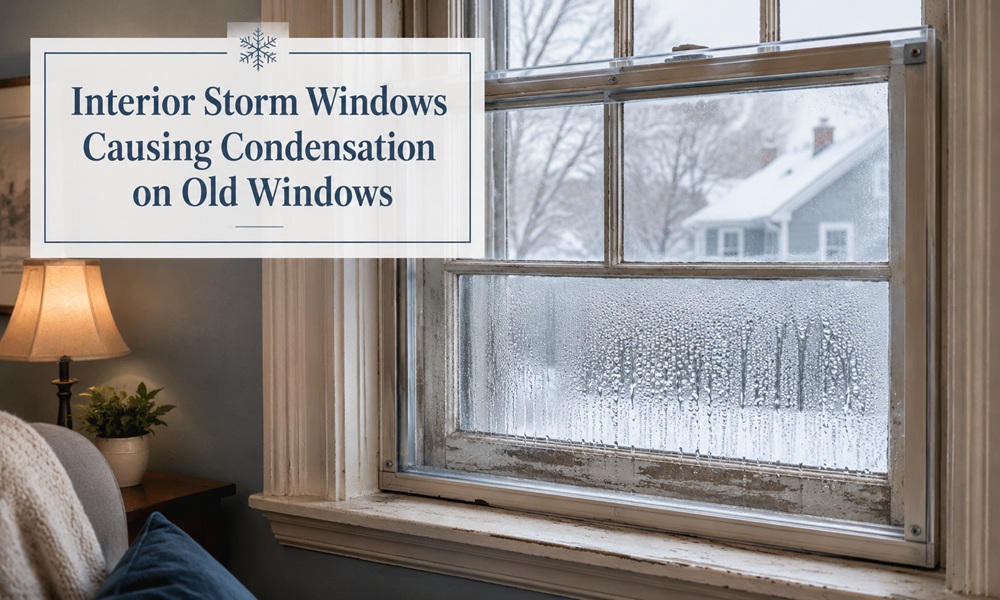
You added interior storm windows to make your old house warmer and quieter, and now there is water fogging the glass behind them. It feels like the storms caused a new problem — but they did not add a drop of moisture to your home. What they changed is the path that warm, humid indoor air takes through the window, and that change is exactly what reveals where your air leaks and humidity were hiding all along. Understanding the physics makes the fix obvious and usually inexpensive. This guide explains why the condensation forms, how to stop it in order of priority, and the subtle sealing balance that protects the historic wood underneath.
The physics in one paragraph
An interior storm window adds a second pane on the room side of your original window. That’s great for comfort — but it creates a sealed air space between the storm and the old glass. If that space is reached by warm, moisture-laden indoor air, the moisture condenses on whichever surface is coldest. With an interior storm, the cold surface is the original (outer) glass, so condensation forms there — a phenomenon called interstitial condensation. It’s the mirror image of the more familiar exterior-storm problem, where moisture collects on the inside of the storm.
Why your interior storm is the trigger
The counter-intuitive part: the storm itself didn’t add moisture — it changed how air and moisture move through the window system. If the interior storm isn’t airtight, indoor humidity passes through the gaps, reaches the cold original glass, and condenses where it now has nowhere to escape. The Building America program is explicit: an interior storm must seal as airtightly as possible to the window frame, or humid air will pass and cause moisture problems.
The bypass most people overlook: even a perfectly sealed storm can fail if humid air sneaks around it through another path — most commonly the sash-weight pulley pockets in old double-hung windows. Air from the wall cavity rises through the pulleys into the space behind the storm. Seal the storm beautifully and you can still get condensation if those pulleys (or gaps at the window weight pockets) are feeding moist air behind it. This is the detail that explains most “but I sealed it perfectly” complaints.
How to fix it — in order
- Air-seal the interior storm to the frame. The tighter the interface between the storm panel and the window frame, the less indoor humidity can reach the cold glass. This is the primary fix.
- Close the bypass paths. Seal sash-weight pulleys (pulley covers) and any gaps at the meeting rail or weight pockets so wall-cavity and room air can’t route behind the storm.
- Lower indoor humidity. Run kitchen and bath exhaust fans, fix basement moisture, and ventilate. Modern double-pane glass tolerates ~37% indoor RH before condensing at 0°F outside; old single glazing tolerates only ~12% — so old glass needs drier indoor air.
- Use a low-E interior storm. Low-E interior storms run warmer on the room side and reduce the condensation potential of the overall window system.
- If condensation persists, hunt the moisture source. New construction, the first weeks of heating season, and cold snaps cause temporary condensation; persistent fogging points to a humidifier, unvented combustion, or a damp basement feeding the house.
Sealed vs. vented: a subtle balance
There’s an important nuance. With an interior storm the priority is a tight room-side seal so humid air never reaches the cold glass. But you don’t want to trap moisture against historic wood either — old wooden sashes need a little air filtering past their edges to stay dry, especially at the lower joints. Over-tightening the original sash can trap moisture and decay the joints. So: seal the interior storm to the frame tightly, but don’t weatherstrip the original sash so aggressively that the wood can never dry. Many specialists deliberately leave a small ventilation gap somewhere in the system to let trapped moisture escape.
When occasional condensation is normal
Not every foggy morning is a problem to solve. A brief film of condensation during a hard cold snap, in the first weeks of the heating season, or in a freshly built or freshly plastered house is usually temporary and harmless as long as it dries by midday. The cases that warrant action are the persistent ones: glass that stays wet, water that pools on the sill, or fogging that recurs every day through the season. Those point to a steady indoor moisture source or a real air-leak path behind the storm, and that is when the steps above pay off.